Executive Summary
Business growth is a thing but it also makes things more complicated. When companies get bigger they need to deal with employees, customers and products. This means their Enterprise Resource Planning systems or ERP systems need to change
Many companies start with Sage. As they grow they need something more. They need a system that can handle work without getting too complicated. Odoo is an option for these companies because it is flexible, scalable and has all the tools they need in one place.
Odoo has emerged as a preferred ERP platform for growth-focused organizations because it combines flexibility, scalability, and integrated business management within a single ecosystem.
Key business objectives include :
Supporting rapid business growth
Improving operational visibility
Simplifying cross-department collaboration
Reducing software fragmentation
Accelerating process automation
Lowering long-term ERP costs
Enabling scalable digital transformation
While Sage is a good system Odoo is better for companies that are growing fast. Odoo has an flexible architecture that helps businesses grow efficiently.
Why Growing Businesses Evaluate Odoo Beyond Sage
As companies get bigger they face challenges. They need to manage business units, warehouses and customers. They need a system that can handle all these changes.
Common evaluation drivers include :
Increasing operational complexity
Growing software licensing costs
Expanding integration requirements
Limited visibility across departments
Demand for business process automation
Need for scalable workflows
Requirement for faster decision-making
Odoo addresses these challenges by providing a range of applications, including CRM, Sales, Accounting, Inventory, Manufacturing, Procurement, HR, Projects, Helpdesk, Marketing and eCommerce all in one place.
Signs Your Current ERP May Be Limiting Business Growth
Many businesses continue operating on legacy ERP environments without realizing how much those systems may be slowing growth.
Your ERP may be creating growth barriers if you experience :
- Increasing dependence on spreadsheets
Multiple disconnected software systems
Limited reporting visibility
Slow implementation of business changes
Growing customization complexity
Delayed decision-making
Difficulty supporting multiple companies or locations
Rising ERP maintenance costs
While these issues may appear manageable individually, together they often create operational bottlenecks that limit scalability.
Sage vs Odoo for High-Growth Organizations
| Feature Area | Sage ERP | Odoo ERP |
|---|---|---|
| Scalability | Moderate–High | High |
| Business Applications | Module-Based | Fully Integrated |
| CRM | Additional Solutions | Built-in |
| Inventory Management | Strong | Strong & Integrated |
| Manufacturing | Available | Strong & Modular |
| HR Management | Limited | Built-in |
| eCommerce | External Integrations | Built-in |
| Reporting | Good | Real-Time & Customizable |
| Automation | Moderate | Extensive |
| Customization | Moderate | Highly Flexible |
| User Experience | Functional | Modern & User-Friendly |
| Multi-Company Support | Available | Strong |
| Deployment | Cloud & On-Premise | Cloud & On-Premise |
Key Insight
The primary difference between Sage and Odoo is not functionality alone—it is scalability through integration.
As businesses grow, managing multiple disconnected systems becomes increasingly difficult. Odoo provides a unified platform where departments share data, workflows, and reporting structures in real time.
This allows organizations to scale operations without creating additional layers of complexity.
When Staying on Sage Makes Sense
ERP modernization is not always necessary.
Sage may remain the preferred option when :
Current business requirements are stable
Existing workflows are optimized
ERP costs remain manageable
User adoption is strong
Existing integrations meet operational needs
Growth plans are relatively predictable
Organizations should evaluate whether their ERP environment can continue supporting future growth before considering migration.
Growth Challenges ERP Systems Must Support
Rapidly growing organizations face unique challenges that require scalable ERP capabilities.
1. Multi-Company Expansion
2. Process Standardization
3. Operational Visibility
4. Business Agility
ERP systems that cannot evolve rapidly may become barriers to growth.
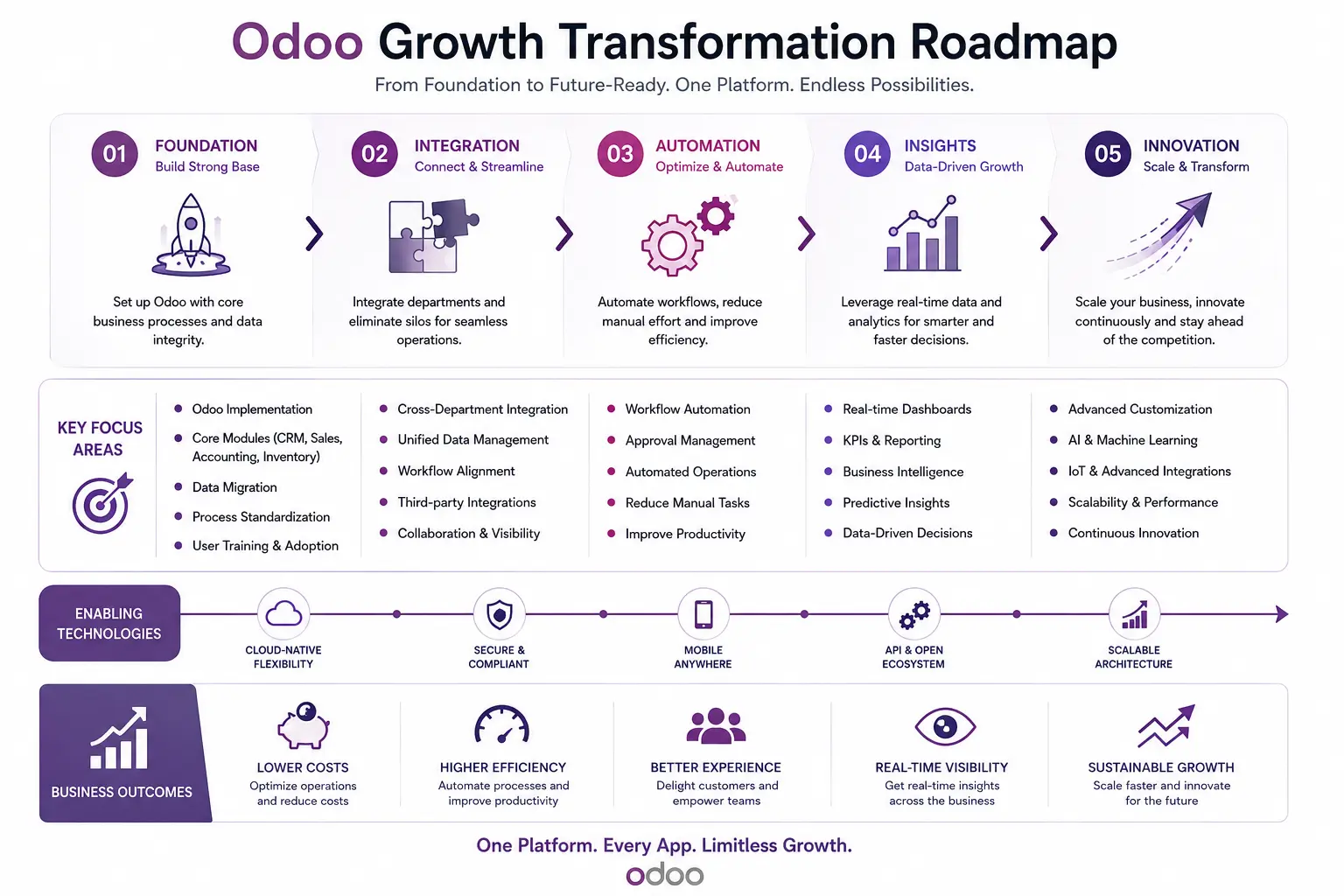
Sage to Odoo ERP Growth Transformation Roadmap
The roadmap below provides a structured framework for organizations transitioning from Sage to Odoo while supporting future scalability.
1. Business Assessment & Growth Planning
Evaluate current systems, operational challenges, future expansion plans, and business objectives.
2. Process Optimization Design
Redesign workflows to eliminate inefficiencies and support scalable operations.
3. Data Migration & Standardization
Prepare customer, supplier, inventory, financial, and operational data for migration.
4. System Configuration & Automation
Configure Odoo applications and automate repetitive business processes.
5. Go-Live Deployment
Transition business operations to Odoo while minimizing disruption.
6. Continuous Improvement & Scaling
Monitor adoption, optimize workflows, and expand ERP functionality as the business grows.
Industry-Specific Considerations
| Industry | Key Growth Focus | Expected Outcome |
|---|---|---|
| Manufacturing | Production Scaling, Inventory Control | Improved Operational Efficiency |
| Distribution | Warehousing, Logistics Expansion | Better Supply Chain Visibility |
| Retail | Multi-Store Operations | Enhanced Customer Experience |
| Professional Services | Project Growth, Resource Planning | Improved Profitability |
| eCommerce | Omnichannel Expansion | Faster Business Scaling |
| Healthcare | Compliance and Process Automation | Improved Operational Control |
Cost and ROI Considerations
ERP modernization should be viewed as an investment in business scalability rather than simply a technology replacement.
Cost Drivers
ERP implementation services
Data migration
Process redesign
User training
Integrations
Infrastructure and hosting
Change management
Value Outcomes
Improved operational visibility
Faster decision-making
Reduced manual processes
Better customer experiences
Increased productivity
Stronger process consistency
Enhanced business scalability
Organizations that align ERP modernization with growth objectives often achieve significantly higher ROI than those focused solely on software replacement.
Common Growth-Related ERP Mistakes
Many businesses unintentionally limit scalability through ERP decisions.
Common mistakes include :
Retaining outdated workflows
Delaying process automation
Excessive customization
Underestimating future growth requirements
Ignoring user adoption challenges
Maintaining disconnected software systems
Failing to standardize business processes
Successful ERP initiatives focus on enabling growth rather than simply managing current operations.
How BrowseInfo Supports Business Growth with Odoo
BrowseInfo helps companies build ERP environments.
Our services include :
ERP assessment and consulting
Sage modernization planning
Growth-focused ERP strategy
Data migration and validation
Odoo implementation and customization
Business process optimization
Third-party integrations
User training and change management
Post go-live optimization
Our goal is to help organizations create flexible, scalable, and future-ready ERP environments that support continued business expansion.
Frequently Asked Questions
1. Why do growing businesses move from Sage to Odoo?
Many organizations seek greater flexibility, stronger integration capabilities, improved scalability, and lower long-term operational costs.
2. Is Odoo suitable for rapidly growing companies?
Yes. Odoo's modular architecture allows businesses to add applications and functionality as requirements evolve.
3. Can Odoo support multi-company operations?
Yes. Odoo provides robust multi-company, multi-currency, and multi-location capabilities.
4. Does Odoo improve operational visibility?
Yes. Odoo provides real-time dashboards, reporting, and integrated workflows across departments.
5. Can Odoo replace multiple business applications?
Yes. Odoo can consolidate CRM, Accounting, Inventory, Manufacturing, Procurement, HR, Projects, Helpdesk, Marketing, and eCommerce into a single platform.
6. Is Odoo easier to customize than Sage?
In many cases, yes. Odoo offers a highly flexible framework that allows organizations to adapt workflows and processes more efficiently.
Final Thoughts
The transition from Sage to Odoo is often driven by a desire to create a scalable and agile business environment. Odoo provides visibility, flexibility, automation and seamless collaboration across departments. While Sage continues to serve businesses effectively companies experiencing rapid growth often find that Odoo offers a more adaptable foundation, for future expansion.
