Introduction
Every growing business eventually reaches a point where spreadsheets, disconnected software, and manual processes can no longer support operations efficiently. Implementing Odoo ERP offers a powerful solution by bringing all critical business functions into a single platform.
However, adopting Odoo is only the beginning. The real challenge lies in implementing it correctly. Without a structured approach, ERP projects can face delays, budget overruns, poor user adoption, and operational disruptions.
This guide explains how a structured Odoo implementation minimizes business risk, improves project success rates, and ensures long-term ROI.
Why ERP Implementations Often Fail
Common Causes of Failure
- Unclear business objectives
- Lack of executive involvement
- Poor data quality and migration planning
- Resistance to organizational change
- Uncontrolled customization and scope creep
Business Impact
- Operational disruptions
- Financial reporting delays
- Reduced productivity
- Increased implementation costs
- Low employee adoption
What Is a Structured Odoo Implementation?
A structured Odoo implementation follows a documented, step-by-step methodology designed to ensure predictable outcomes.
Core Principles
- Business Alignment – ERP supports strategic goals.
- Transparency – Stakeholders stay informed throughout the project.
- Controlled Agility – Flexibility without losing project control.
Key Benefits
- Reduced implementation risks
- Better budget control
- Faster user adoption
- Improved project visibility
- Easier future upgrades

The Odoo Implementation Lifecycle
1. Discovery & Business Analysis
- Document current workflows
- Identify inefficiencies
- Define future-state processes
- Establish measurable objectives
2. Gap Analysis & Solution Design
- Compare business needs with standard Odoo features
- Identify customization requirements
- Evaluate process improvements
3. System Configuration
- Configure modules
- Set user permissions
- Define accounting and tax structures
- Prepare testing environments
4. Development & Customization
- Build approved custom features
- Integrate third-party applications
- Maintain strict scope control
5. Data Migration
- Audit legacy data
- Clean and validate records
- Map data fields
- Execute test migrations
6. User Acceptance Testing (UAT)
- Validate workflows
- Identify issues
- Confirm business requirements are met
7. Go-Live Deployment
- Execute final migration
- Switch operations to Odoo
- Monitor system performance
8. Post-Go-Live Support
- Resolve issues quickly
- Assist users
- Optimize processes
Standard Odoo vs Custom Development
| Standard Odoo | Custom Development |
|---|---|
| Faster implementation | Longer deployment |
| Lower costs | Higher costs |
| Easier upgrades | Increased maintenance |
| Lower risk | Higher complexity |
Reducing Data Migration Risks
Key Steps
- Data auditing
- Data cleansing
- Data mapping
- Trial migrations
- Validation testing
A clean database ensures accurate reporting, inventory tracking, and financial management from day one.
Controlling ERP Costs
A structured methodology helps prevent budget overruns by:
- Defining requirements upfront
- Limiting unnecessary customization
- Managing timelines effectively
- Assigning clear responsibilities
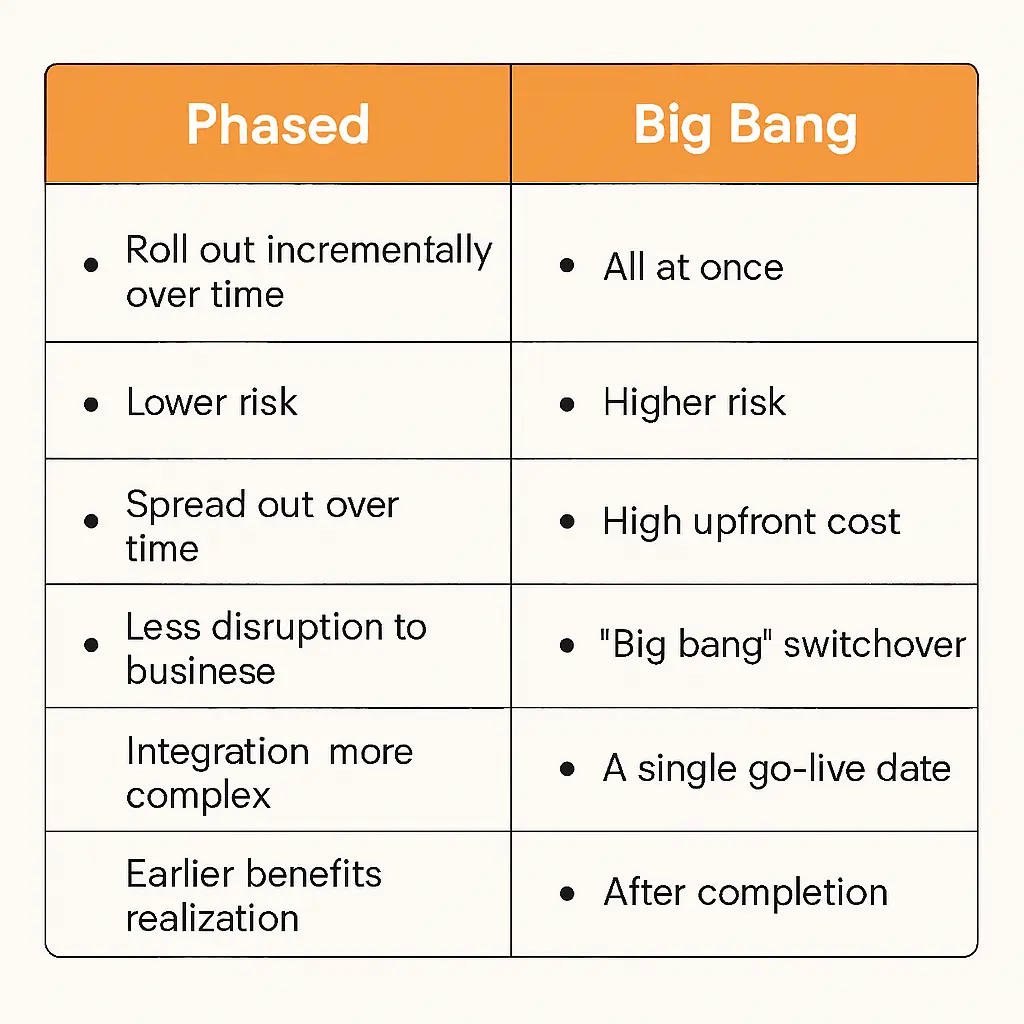
Choosing the Right Deployment Strategy
Big Bang Deployment
Advantages
- Faster implementation
- No parallel systems
Challenges
- Higher operational risk
- Requires intensive training
Phased Deployment
Advantages
- Lower risk
- Easier user adaptation
Challenges
- Longer implementation timeline
- Additional integration requirements
Change Management & User Adoption
Technology alone doesn't guarantee success. Employees must embrace the new system.
Effective Change Management Strategies
- Communicate benefits clearly
- Involve users early
- Address concerns proactively
- Establish internal champions
Odoo Training Best Practices
- Identify super-users
- Use role-based training
- Create process-specific documentation
- Implement train-the-trainer programs
Odoo Implementation Checklist
Pre-Implementation
✔ Define business goals
✔ Secure executive sponsorship
✔ Build project team
✔ Audit existing systems
Design & Planning
✔ Map business processes
✔ Conduct gap analysis
✔ Finalize requirements
✔ Approve project scope
Setup & Development
✔ Configure Odoo environment
✔ Set user permissions
✔ Build approved customizations
✔ Clean legacy data
Testing & Training
✔ Conduct data migration tests
✔ Perform UAT
✔ Train users
✔ Finalize change management plan
Go-Live
✔ Complete final migration
✔ Validate data accuracy
✔ Launch system
✔ Provide hyper-care support
Selecting the Right Odoo Implementation Partner
Look for a partner with:
- Proven Odoo expertise
- Industry-specific experience
- Structured implementation methodology
- Strong communication practices
- Long-term support capabilities
Measuring Odoo Implementation Success
Track ERP ROI using metrics such as:
- Inventory accuracy
- Month-end closing time
- Sales cycle efficiency
- Order fulfillment speed
- Operational productivity
- IT cost reduction
Frequently Asked Questions (FAQs)
1. What is a structured Odoo implementation?
A structured Odoo implementation is a planned and methodical approach to deploying Odoo ERP. It includes business analysis, system configuration, data migration, testing, training, and post-launch support to minimize risks and ensure successful adoption.
2. How does a structured Odoo implementation reduce business risk?
It reduces risk by establishing clear project objectives, controlling scope changes, ensuring accurate data migration, improving user adoption, and following a proven implementation methodology throughout the project lifecycle.
3. What are the biggest challenges during an Odoo implementation?
Common challenges include poor data quality, scope creep, inadequate user training, resistance to change, and excessive customization. A structured implementation approach helps address these issues before they impact the project.
4. Should businesses customize Odoo or use standard features?
Businesses should prioritize standard Odoo features whenever possible. Standard functionality reduces implementation costs, shortens deployment time, simplifies upgrades, and lowers long-term maintenance requirements.
5. Why is user training important for Odoo implementation success?
User training ensures employees understand how to use Odoo effectively, improves adoption rates, reduces operational errors, and helps organizations achieve maximum value from their ERP investment.
Conclusion
A successful Odoo implementation is not just about deploying software—it is about managing change, controlling risks, and aligning technology with business goals. By following a structured implementation methodology, organizations can reduce project risks, improve user adoption, maintain budget control, and achieve long-term business growth.
