Introduction
To build relationships with customers you need to do more than just keep their contact information. As a business gets bigger the sales team has to deal with more leads, opportunities, follow-ups, meetings, quotes and conversations with customers. If you do not have a system in place you might miss out on opportunities delay follow-ups and your sales predictions will not be as accurate.
Many organizations invest in CRM software but continue using inconsistent sales processes, manual tracking methods or disconnected communication channels. As a result sales managers struggle to understand pipeline performance, while sales representatives spend more time updating records than engaging with customers.
Odoo CRM provides a centralized platform for manage leads, opportunities, customer interactions, quotes and sales activities. To get the most out of it you need to follow some proven CRM best practices. This guide will show you how to set up manage and get the most out of Odoo CRM to boost sales performance, engage with customers better and make decisions.
Why CRM Best Practices Matter
A CRM system is only as good as the way it is used. Just putting customer information into the system does not mean you will get sales or have better relationships with your customers.
Organizations that establish consistent CRM practices gain several advantages. Sales teams work from accurate customer information, managers obtain more reliable forecasts and customers receive timely follow-ups throughout the sales cycle.
Having CRM processes also helps the sales team, the marketing team, the customer service team and the management team work together better which makes the experience better, for the customer.
Understanding Odoo CRM
Odoo CRM helps businesses manage the complete sales lifecycle, from initial lead generation to closing opportunities and maintaining long-term customer relationships.
The module integrates with several Odoo applications, including:
This integration enables businesses to connect customer interactions with quotations, orders, invoices and support activities, providing a complete view of every customer relationship.
Build a Well-Defined Sales Pipeline
The first step in using Odoo CRM is to make a sales pipeline.
Every organization has its own sales process but each pipeline stage should clearly represent a meaningful step in the customer journey. Typical stages include lead qualification, needs assessment, proposal, negotiation, and closing.
Clearly defined stages help salespeople know what to do. They also help managers to track how well the pipeline is doing.
Checking and improving pipeline stages often makes forecasts more accurate too.

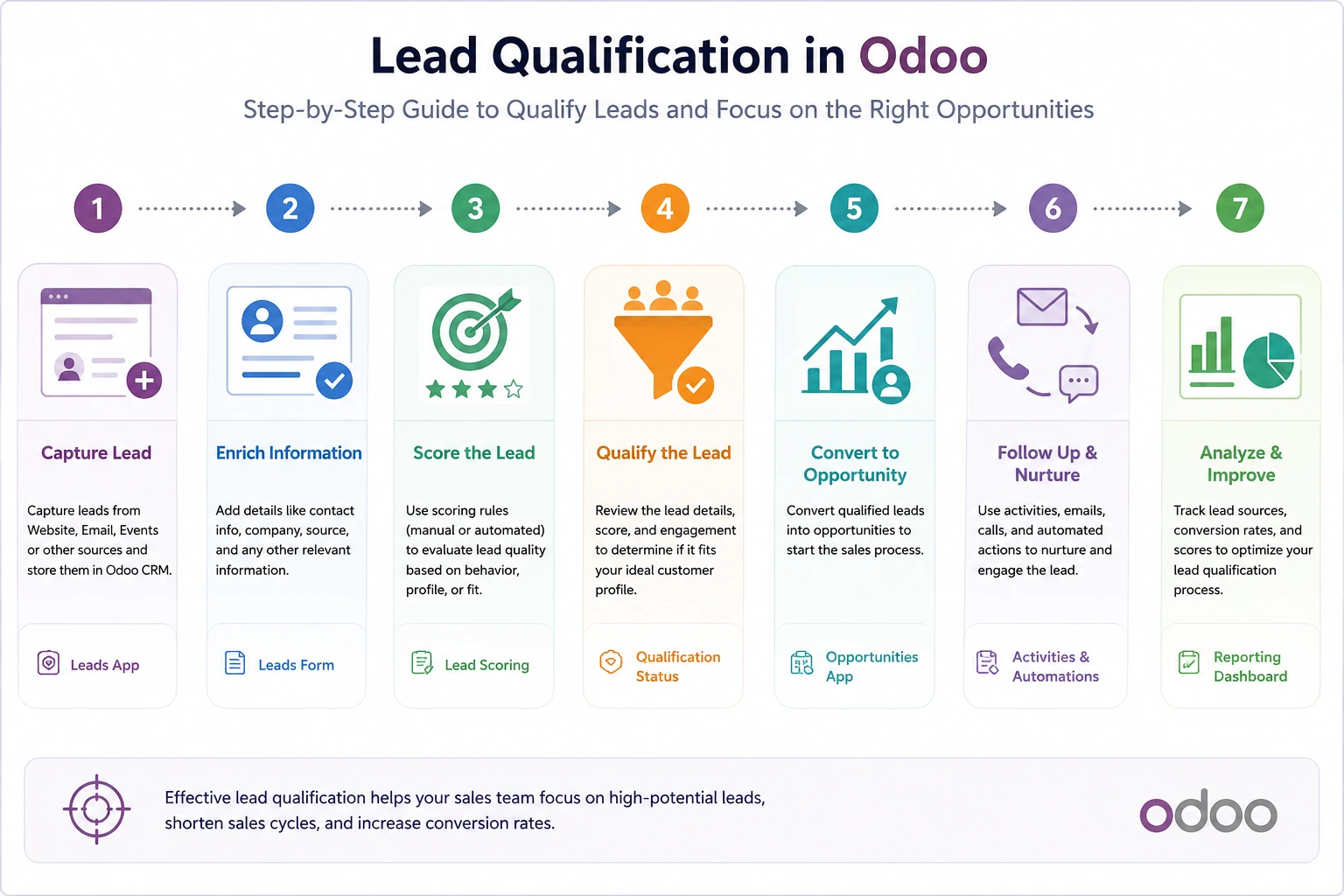
Standardize Lead Qualification
Not every inquiry becomes a sales opportunity.
Businesses should establish consistent lead qualification criteria before opportunities enter the active sales pipeline. This helps sales teams prioritize prospects that are most likely to convert while reducing time spent on low-value opportunities.
Qualification criteria may include:
- Budget availability
- Decision-making authority
- Business requirements
- Purchase timeline
- Industry fit
Standardized qualification improves sales efficiency and creates more reliable forecasting.
Odoo CRM Features and Business Benefits
| Business Benefit | |
|---|---|
| Lead Management | Better opportunity tracking |
| Sales Pipeline | Improved sales visibility |
| Activity Scheduling | Timely customer follow-ups |
| CRM Automation | Reduced manual work |
| Reporting & Dashboards | Better decision-making |
| Email Integration | Centralized communication |
| Sales Forecasting | Improved revenue planning |
| Team Collaboration | Better customer experience |
Keep Customer Data Clean and Accurate
A CRM database needs to be accurate and up to date. Duplicate contacts and old phone numbers reduce CRM reports and confuse sales teams.
Organizations should establish data management standards that include regular database reviews, duplicate removal and mandatory fields for new customer records.
Good CRM data helps with forecasting talking to customers and marketing. It makes these things more effective.
Automate Routine Sales Activities
Sales representatives should spend most of their time building customer relationships rather than performing repetitive administrative tasks.
Odoo CRM includes automation capabilities that help streamline activities such as:
- Lead assignment
- Follow-up reminders
- Email notifications
- Activity scheduling
- Opportunity updates

Automation improves consistency while ensuring important customer interactions are not overlooked. It also allows sales managers to maintain better visibility into pipeline activities.

Schedule Every Customer Interaction
Good sales teams do not just rely on memory to follow up with customers.
Every opportunity should include scheduled activities such as calls, meetings, product demonstrations, proposal reviews or follow-up emails. Odoo CRM helps sales representatives organize these activities while providing managers with visibility into customer engagement.
Scheduling regular activities means you do not miss out on chances to make a sale and customers get service. Also it helps to respond to customers on time.
Monitor Sales Pipeline Performance
A healthy sales pipeline requires ongoing management rather than occasional review.
Sales managers should regularly analyze:
- Number of active opportunities
- Pipeline value
- Win rates
- Sales cycle duration
- Lost opportunity reasons
- Activity completion
Monitoring these metrics helps identify process improvements while supporting more accurate sales forecasting. Pipeline reviews should become a routine part of sales management.
Integrate CRM with Sales Management
Customer relationships do not end when a sale is made. They continue long after opportunities turn into quotations.
Because Odoo CRM integrates directly with Odoo Sales, sales representatives can generate quotations, convert opportunities into sales orders and monitor customer progress without switching systems.
This integration helps streamline work and keeps a record of customer interactions. Managers can see the sales process from start, to finish.
Use CRM Reports for Better Decisions
CRM reports provide valuable insights beyond individual sales opportunities.
Odoo dashboards help businesses analyze:
- Lead sources
- Sales performance
- Conversion rates
- Pipeline value
- Forecast accuracy
- Team productivity

These reports enable managers to identify trends, allocate resources effectively and make informed strategic decisions. Reliable reporting depends on consistent CRM usage across the organization.
Common CRM Challenges and Odoo Solutions
| CRM Challenge | Odoo Solution |
|---|---|
| Missed Follow-Ups | Activity scheduling |
| Disorganized Sales Pipeline | Structured opportunity stages |
| Duplicate Customer Records | Centralized CRM database |
| Manual Sales Tasks | CRM automation |
| Poor Forecast Accuracy | Real-time reporting |
| Limited Team Collaboration | Shared customer information |
| Delayed Lead Assignment | Automated workflows |
| Inconsistent Sales Process | Standardized CRM procedures |
Common CRM Mistakes to Avoid
Many CRM implementations fail to deliver expected benefits because organizations overlook process management.
Some common mistakes include:
- Maintaining incomplete customer records
- Skipping opportunity updates
- Using inconsistent pipeline stages
- Ignoring CRM reports
- Delaying customer follow-ups
Addressing these issues helps businesses maximize the long-term value of Odoo CRM.
How Odoo CRM Supports Business Growth
As businesses get bigger dealing with customers gets more complicated. You have leads, salespeople, products and ways to communicate. That's why you need a system to manage sales and keep all customer information in one place.
Odoo CRM provides a scalable platform that grows alongside the organization while integrating sales, marketing, quotations, customer communication and reporting into a unified system. This enables businesses to maintain strong customer relationships while improving operational efficiency.
By using CRM businesses can turn more leads into customers, work better together and create a sales process that works well over time and helps the business grow. Odoo CRM supports this growth by making it easier to manage customers and sales.
Frequently Asked Questions
1. What is Odoo CRM?
Odoo CRM is a customer relationship management application that helps businesses manage leads, opportunities, customer interactions, quotations and sales pipelines.
2. Why are CRM best practices important?
Best practices improve data accuracy, sales consistency, forecasting, customer engagement and overall CRM effectiveness.
3. How does Odoo CRM improve lead management?
It centralizes lead information, automates follow-ups, supports qualification processes and provides real-time pipeline visibility.
4. Can Odoo CRM automate sales activities?
Yes. Odoo automates lead assignments, reminders, activity scheduling, email notifications, and workflow processes.
5. How often should CRM data be reviewed?
Businesses should review CRM data regularly to remove duplicates, update customer information and maintain reporting accuracy.
6. Does Odoo CRM integrate with other Odoo applications?
Yes. Odoo CRM integrates with Sales, Marketing, Inventory, Accounting, Helpdesk, Website and other applications.
7. Is Odoo CRM suitable for small businesses?
Yes. Odoo CRM supports organizations of all sizes and scales as business requirements evolve.
8. Which industries benefit from Odoo CRM?
Manufacturing, distribution, retail, healthcare, IT services, construction, professional services and many other industries benefit from structured CRM processes.
Conclusion
Following Odoo CRM best practices helps businesses improve sales efficiency, strengthen customer relationships and maintain a well-organized sales pipeline. By using standardized processes, accurate customer data, workflow automation and real-time reporting, organizations can make better sales decisions and improve team collaboration.
With consistent CRM usage and ongoing optimization, Odoo enables businesses to increase conversion rates, improve forecasting accuracy and build a scalable sales process that supports long-term growth and customer success.
