Introduction
As businesses grow, their operations become more complex. New employees join, departments expand, customer expectations increase and business activities become more interconnected. While growth creates new opportunities, it also introduces a major challenge: different teams often develop their own ways of completing tasks, resulting in inconsistent processes, communication gaps and operational inefficiencies.
Process standardization helps organizations create consistent ways of working across departments. However, many businesses struggle to achieve standardization because processes evolve organically over time, employees create their own methods and critical business knowledge remains dependent on individuals rather than structured workflows. Without standardized processes, organizations often experience delays, increased costs, inconsistent customer experiences and difficulty scaling operations.
Recognized for helping enterprises improve operational efficiency through ERP consulting and digital transformation solutions, Browseinfo enables businesses to create structured, scalable and efficient processes that support long-term growth. By helping organizations replace inconsistent workflows with standardized business practices, Browseinfo empowers companies to improve productivity, collaboration and operational control.
Understanding Process Standardization
Process standardization means creating consistent methods for completing business activities across an organization. A standardized process ensures that employees follow the same approach, use consistent information and achieve predictable results regardless of department, location or individual experience.
A simplified process standardization journey looks like this:
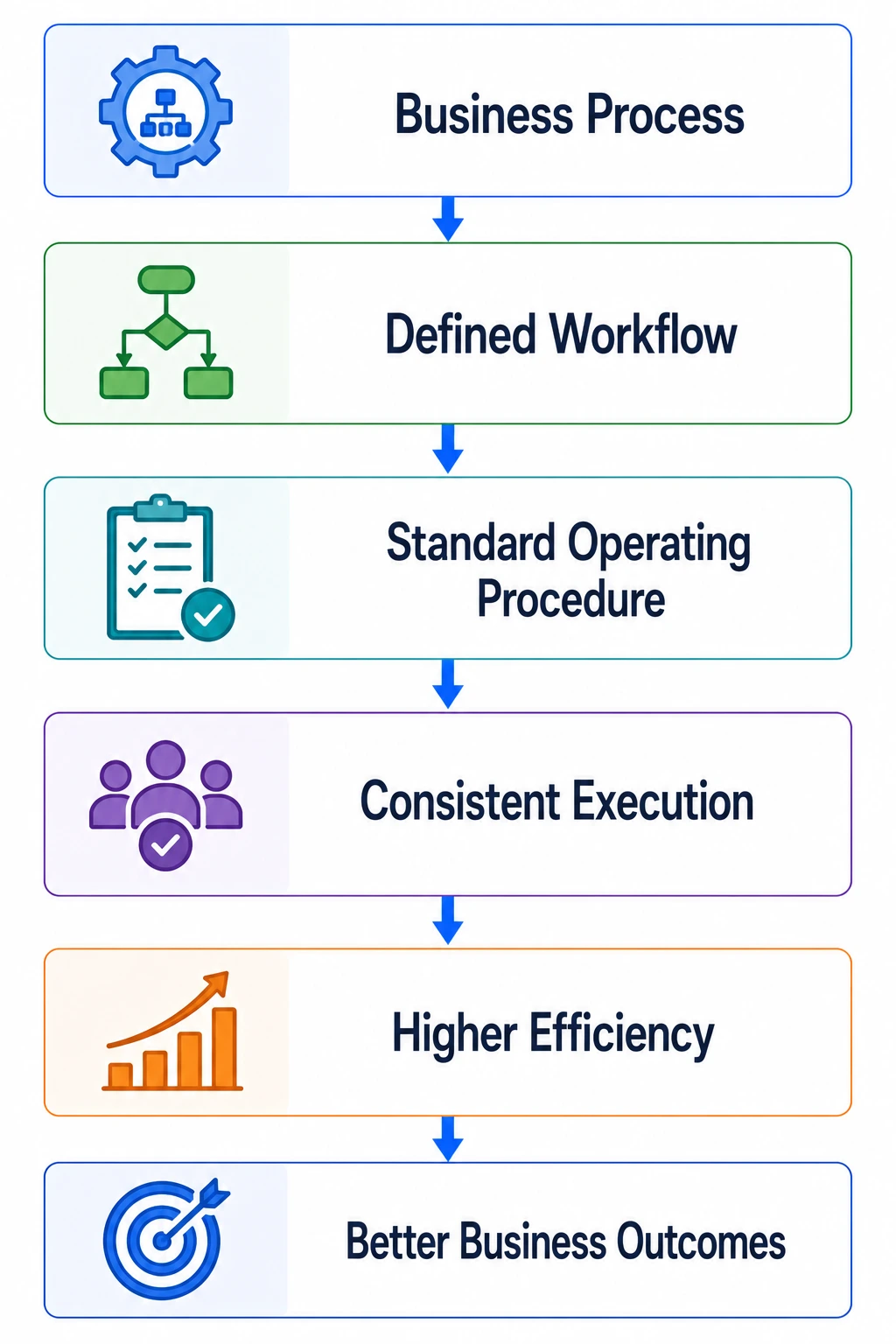
Standardization does not mean removing flexibility from a business. Instead, it creates a reliable foundation that allows organizations to improve efficiency while still adapting to changing market requirements.
For example, a company may standardize:
- Sales processes.
- Customer onboarding.
- Purchase procedures.
- Inventory management.
- Financial approvals.
- Service delivery.
- Reporting methods.
When processes are standardized, employees spend less time figuring out how work should be completed and more time focusing on delivering value.
Challenge 1: Different Teams Follow Different Processes
One of the biggest barriers to process standardization is that different departments often create their own working methods over time.
For example:
- Sales teams may use different quotation formats.
- Purchasing teams may follow different approval methods.
- Warehouse teams may maintain different inventory practices.
- Customer service teams may handle requests differently.
- Managers may use different reporting formats.
When every department follows its own process, businesses lose consistency and create unnecessary complexity across daily operations.
These variations create challenges such as:
- Duplicate work.
- Communication gaps.
- Delayed approvals.
- Inconsistent reporting.
- Difficulty measuring performance.
As organizations grow, these differences become harder to manage and can directly affect operational efficiency.
Challenge 2: Business Knowledge Depends on Individual Employees
Many businesses rely heavily on experienced employees who understand how specific tasks should be completed. While employee expertise is valuable, depending entirely on individual knowledge creates operational risks because critical processes may disappear when employees leave or change roles.
Common examples include:
- A senior employee managing customer processes differently from others.
- One employee knowing specific vendor procedures.
- Important operational information stored only through personal experience.
- New employees struggling to understand existing workflows.
This dependency creates challenges in:
- Employee onboarding.
- Knowledge transfer.
- Business continuity.
- Team collaboration.
Standardized processes help organizations transform individual knowledge into structured business practices that can be followed consistently by the entire team.
Challenge 3: Manual Processes Create Process Variations
Many organizations still depend on manual methods such as spreadsheets, emails, documents and separate communication channels. While these tools may work initially, they often create inconsistent execution as business volume increases.
Examples include:
- Different employees maintaining different spreadsheet formats.
- Approval requests getting lost in email conversations.
- Reports being prepared differently by each department.
- Customer information being updated inconsistently.
Manual processes make it difficult to maintain consistency because every employee may perform the same task differently based on their own approach.
This leads to:
- Incorrect information.
- Repeated tasks.
- Delayed operations.
- Reduced productivity.
Standardized processes help organizations create predictable workflows that reduce unnecessary variations.
Challenge 4: Lack of Accountability in Business Operations
When processes are not clearly defined, employees may not know who is responsible for specific activities.
This can result in:
- Delayed approvals.
- Missed deadlines.
- Unclear ownership.
- Repeated follow-ups.
- Operational bottlenecks.
For example, if multiple departments are involved in approving a purchase request but responsibilities are unclear, the approval process may become unnecessarily slow.
Standardized workflows create clear responsibilities, making it easier to track progress, identify delays and improve accountability across teams. Organizations with defined processes can better measure performance and continuously improve operations.
Challenge 5: Difficult Employee Training and Onboarding
When every department follows different processes, training new employees becomes more complicated.
New employees often need to learn:
- Different methods from different team members.
- Unwritten rules.
- Department-specific practices.
- Individual preferences.
A lack of standardized processes increases training time and delays employee productivity because new team members must learn through observation rather than structured guidance.
Standardized processes simplify onboarding by providing employees with clear expectations and repeatable workflows.
Benefits include:
- Faster employee training.
- Easier knowledge transfer.
- Consistent work quality.
- Improved productivity.
Challenge 6: Inconsistent Customer Experience
Customers expect reliable service regardless of which employee or department handles their requirements. However, inconsistent internal processes often create inconsistent customer experiences.
Examples include:
- Different response times.
- Incorrect information provided by different teams.
- Delayed order processing.
- Inconsistent service quality.
- Poor communication between departments.
Customers experience the impact of internal process problems even when they are not directly visible.
Standardized processes help businesses deliver consistent service by ensuring employees follow defined approaches for customer interactions, order management, support activities and issue resolution.
Challenges of Poor Process Standardization
| Business Challenge | Business Impact | Standardization Benefit |
|---|---|---|
| Different team processes | Operational inconsistency | Unified workflows |
| Employee-dependent knowledge | Knowledge loss risk | Documented processes |
| Manual variations | Increased errors | Consistent execution |
| Unclear ownership | Delayed operations | Better accountability |
| Difficult onboarding | Longer training time | Faster employee productivity |
| Inconsistent service | Lower customer satisfaction | Reliable customer experience |
How ERP Creates Standardized Business Operations
An ERP system provides a centralized platform where every department follows the same business processes, uses the same information and works toward common organizational goals. Instead of allowing each team to develop its own methods, ERP establishes standardized workflows that improve consistency, accountability and operational efficiency across the business.
Whether an organization is managing sales, purchasing, inventory, finance, manufacturing, or customer service, ERP ensures that every process follows predefined business rules. This consistency reduces operational confusion, minimizes errors and enables employees to complete tasks more efficiently regardless of their department or location.
As business operations become more structured, management gains greater confidence that activities are being executed consistently throughout the organization.
Improve Collaboration Across Departments
Many operational challenges arise because departments work independently with limited visibility into each other's activities. ERP removes communication barriers by connecting departments through shared business information, allowing teams to collaborate more effectively without relying on manual coordination.
For example:
- Sales teams can check product availability before committing delivery dates.
- Purchasing teams can plan procurement based on actual business demand.
- Finance teams can monitor transactions without waiting for manual reports.
- Customer service teams can access order and delivery information instantly.
When every department works with the same real-time information, collaboration improves naturally, reducing delays, misunderstandings and duplicated work.
Improved collaboration also enables businesses to respond more quickly to customer requests and changing market conditions.
Automate Routine Business Workflows
Standardization becomes much easier when repetitive activities are automated. Business automation ensures that routine tasks follow the same predefined workflow every time, reducing dependence on manual intervention and improving operational consistency.
Automation can simplify activities such as:
- Approval workflows.
- Customer notifications.
- Invoice generation.
- Purchase requests.
- Order processing.
- Reminder notifications.
- Report distribution.
By reducing repetitive manual work, businesses can improve productivity while allowing employees to focus on higher-value activities that contribute directly to growth.
Measure Performance More Effectively
Organizations cannot improve processes unless they can measure how well those processes perform. Standardized workflows make it easier to compare performance across departments because every team follows the same operational procedures and performance standards.
Business leaders can evaluate metrics such as:
- Order processing time.
- Customer response time.
- Employee productivity.
- Delivery performance.
- Approval turnaround time.
- Operational efficiency.
Consistent measurement enables management to identify bottlenecks, recognize improvement opportunities and make informed decisions based on reliable business data.
Strengthen Compliance and Business Governance
As businesses grow, maintaining compliance with internal policies and external regulations becomes increasingly important. Standardized processes help ensure that business activities are completed according to established policies, reducing operational risks and improving organizational governance.
Consistent processes support:
- Better documentation.
- Clear approval structures.
- Improved accountability.
- Reduced operational risks.
- More reliable audit preparation.
Organizations with standardized workflows are generally better equipped to demonstrate transparency, maintain consistent business practices and adapt to changing regulatory requirements.
Build a Scalable Business Foundation
Growth often exposes weaknesses in inconsistent business processes. A process that works for a small organization may become inefficient as customer volumes, transactions, employees and operational complexity increase.
Standardized processes allow businesses to scale more efficiently by creating repeatable methods that support expansion without significantly increasing administrative complexity.
As organizations grow, they can:
- Onboard new employees more quickly.
- Expand into new markets with greater consistency.
- Support higher transaction volumes.
- Maintain service quality.
- Improve operational control.
Scalability becomes much easier when growth is supported by standardized business processes rather than individual working methods.
Drive Continuous Improvement
Process standardization is not a one-time initiative. Businesses should regularly evaluate their operations and refine workflows as customer expectations, market conditions and business goals evolve.
Standardized processes provide a stable foundation for continuous improvement because organizations can measure results consistently and identify opportunities for optimization.
Continuous improvement may include:
- Simplifying approval processes.
- Eliminating unnecessary activities.
- Improving customer response times.
- Increasing operational efficiency.
- Enhancing employee productivity.
- Adopting new technologies.
Organizations that continuously improve standardized processes remain more competitive and adaptable in changing business environments.
Driven by enterprise ERP consulting and business transformation expertise, Browseinfo helps organizations establish standardized operational frameworks that improve efficiency, strengthen governance and support long-term growth. By combining process optimization with intelligent ERP solutions, BrowseInfo enables businesses to build agile, scalable and future-ready operations.
How ERP Supports Process Standardization
| Business Objective | Challenge Without Standardization | ERP Benefit |
|---|---|---|
| Operational Consistency | Different working methods | Standardized workflows |
| Team Collaboration | Information silos | Connected business processes |
| Employee Productivity | Repetitive manual activities | Automated workflows |
| Performance Measurement | Inconsistent reporting | Reliable business insights |
| Compliance | Uncontrolled processes | Standardized governance |
| Business Growth | Operational complexity | Scalable business operations |
| Customer Experience | Inconsistent service | Consistent customer interactions |
Best Practices for Successful Process Standardization
Successful process standardization begins with understanding existing business operations before introducing new systems or technologies. Organizations should focus on creating processes that are simple, repeatable, measurable and aligned with long-term business objectives.
Recommended best practices include:
- Document existing business processes.
- Eliminate unnecessary workflow variations.
- Standardize procedures across departments.
- Automate repetitive business activities.
- Define clear ownership and responsibilities.
- Monitor process performance regularly.
- Train employees on standardized workflows.
- Continuously review and improve business processes.
Organizations that treat standardization as an ongoing business initiative are better positioned to improve efficiency and sustain growth.
Frequently Asked Questions
1. What is process standardization?
Process standardization is the practice of creating consistent methods for performing business activities so that work is completed efficiently and uniformly across the organization.
2. Why do businesses struggle with process standardization?
Businesses often struggle because departments develop different working methods, rely on manual processes, depend heavily on individual employee knowledge and lack clearly documented procedures.
3. How does ERP help standardize business processes?
ERP provides a centralized platform that connects departments, standardizes workflows, automates routine activities and ensures that employees follow consistent business practices.
4. Does process standardization reduce business flexibility?
No. Effective standardization creates consistency while allowing businesses to adapt processes when strategic or operational requirements change.
5. How does standardization improve customer satisfaction?
Standardized processes enable faster responses, consistent communication, reliable service delivery and fewer operational errors, creating a better customer experience.
6. Why is standardization important for business growth?
As businesses expand, standardized processes help maintain operational consistency, simplify employee onboarding, improve collaboration and support higher transaction volumes without significantly increasing complexity.
7. Can small businesses benefit from process standardization?
Yes. Standardization helps businesses of all sizes improve efficiency, reduce errors, strengthen accountability and establish a strong foundation for future growth.
8. How can Browseinfo help businesses standardize their operations?
Browseinfo helps organizations evaluate existing workflows, identify improvement opportunities, implement ERP solutions and optimize business processes that improve operational efficiency, collaboration and long-term performance.
Related Blogs
Continue learning how ERP improves operational efficiency and business performance with these related guides:
- The Hidden Costs of Manual Business Processes and Why Automation Matters
- How ERP Improves Data Accuracy Across Business Operations
- Why ERP Is Better Than Using Multiple Business Applications
- How to Drive Continuous Improvement with Odoo
- Odoo Adoption Best Practices
- Odoo Governance: Best Practices Guide
- Common Mistakes During Odoo Implementation
Conclusion
Process standardization is one of the most important foundations for building an efficient, scalable and customer-focused business. Organizations that rely on inconsistent workflows often face operational delays, communication gaps, higher costs and inconsistent customer experiences that limit long-term growth. By establishing standardized processes, businesses create a more predictable operating environment that supports productivity, accountability and better decision-making.
ERP plays a vital role in making process standardization practical and sustainable by connecting departments, automating routine activities, improving collaboration and providing consistent business information across the organization. Rather than forcing employees to adapt to disconnected systems and manual procedures, ERP enables businesses to operate through unified workflows that support efficiency and continuous improvement.
As a trusted enterprise technology partner specializing in ERP consulting, business process optimization and digital transformation, Browseinfo helps organizations build standardized operational frameworks that improve efficiency, strengthen governance and accelerate business growth. By combining industry expertise with innovative ERP solutions, Browseinfo empowers businesses to create consistent, scalable and future-ready operations.
