Executive Summary
Customer relationship management has changed. It is not about managing leads and opportunities anymore. Now businesses need CRM platforms that connect sales, project delivery, customer service, billing and daily operations.
When comparing CRM and Odoo CRM businesses usually think about sales pipeline management, project teamwork, workflow automation, ease of implementation, user adoption and total cost. Insightly CRM is known for connecting CRM and project management in one platform. Odoo CRM takes it further by integrating CRM with ERP, accounting, inventory, helpdesk, project management and business operations.
Key business objectives include :
Improved lead-to-project visibility
Better project delivery coordination
Faster sales cycle management
Enhanced customer collaboration
Reduced operational silos
Lower software ownership costs
Greater workflow automation
Complete customer lifecycle visibility
Insightly focuses on connecting customer relationships with project execution. Odoo provides a business ecosystem to manage every stage of the customer journey from lead generation to project completion and invoicing.
Why Companies Compare Insightly CRM and Odoo CRM?
Businesses evaluating CRM solutions often need a platform that supports both customer acquisition and project delivery.
Many service-based businesses initially choose Insightly because it combines CRM and project management. As they grow they often require integration between sales, accounting, procurement, inventory, support, resource planning and customer service.
Common evaluation drivers include :
Growing project management requirements
Need for end-to-end customer visibility
Demand for integrated business applications
Increasing operational complexity
Requirement for workflow automation
Desire for centralized reporting
Need to reduce software fragmentation
Odoo CRM provides an integrated ecosystem where CRM, Sales, Projects, Accounting, Helpdesk, Inventory, Procurement, Marketing Automation, Human Resources and eCommerce all work together in one platform.

Signs Your Current CRM May Be Limiting Growth
Your CRM environment may be creating operational challenges if you experience :
Limited visibility between sales and project teams
Multiple disconnected business systems
Manual handoffs between departments
Increasing integration maintenance costs
Duplicate customer information
Limited operational reporting
Complex workflow management
Growing software subscription expenses
As organizations expand, these challenges can reduce efficiency, slow project delivery and negatively impact customer satisfaction.
Insightly CRM vs Odoo CRM Strategic Comparison
| Feature Area | Insightly CRM | Odoo CRM |
|---|---|---|
| Lead Management | Strong | Advanced |
| Opportunity Management | Strong | Advanced |
| Project Management | Built-in | Advanced & Integrated |
| Task Management | Built-in | Built-in |
| Workflow Automation | Strong | Highly Flexible |
| Customer Journey Visibility | Strong | End-to-End |
| Quotation Management | Limited | Native |
| Sales Orders | Limited | Native |
| Accounting Integration | External | Built-in |
| Helpdesk Integration | Limited | Native |
| Inventory Integration | External | Native |
| Resource Planning | Limited | Built-in |
| Reporting | Strong | Real-Time & Customizable |
| Customization | Moderate | Highly Flexible |
| Scalability | High | High |
| Deployment | Cloud | Cloud & On-Premise |
| Total Cost of Ownership | Medium | Low–Medium |
Key Insight
Insightly CRM does a job of bringing together customer management and project delivery. This makes it a good choice for service firms and project-based organizations.
Odoo CRM takes this a step further by linking sales pipelines to project execution, accounting, invoicing, inventory, procurement, customer support and ERP operations.
For organizations that want to see everything thats happening in their business Odoos unified system often works better as the business gets more complex.
When Staying on Insightly CRM Makes Sense
CRM modernization is not always required.
Insightly CRM may remain the preferred solution when :
Existing CRM and project workflows are optimized
Project management is the primary operational requirement
Current integrations perform effectively
User adoption remains strong
Business processes are relatively stable
ERP functionality is not required
For organizations that are mainly focused on CRM and project coordination Insightly might still be providing value.
CRM Migration Risks
Successful CRM modernization requires careful planning and governance.
1. Data Migration Risk
Bad data can hurt your reporting and visibility. This includes poor-quality customer, opportunity, project and activity data.
2. Process Redesign Risk
Moving to a system without optimizing your workflows can limit the benefits of modernization.
3. User Adoption Risk
If you don't train your users and involve them in the process they might struggle to adapt to workflows and integrated processes.
Industry-Specific Considerations
| Industry | Key Focus Areas | Outcome |
|---|---|---|
| Professional Services | Lead-to-Project Management | Improved Delivery Efficiency |
| Consulting | Resource Planning & Billing | Better Profitability |
| IT Services | Customer & Project Visibility | Improved Service Delivery |
| Marketing Agencies | Campaign & Project Tracking | Better Collaboration |
| Construction Services | Customer-to-Project Lifecycle | Enhanced Operational Control |
| Engineering Firms | Project Execution & Reporting | Increased Productivity |
Cost and ROI Considerations
CRM modernization should be evaluated based on business outcomes rather than software costs alone.
Cost Drivers
Software licensing
CRM implementation services
Data migration
Workflow automation
User training
Integration development
Customization requirements
Value Outcomes
Improved project visibility
Faster project delivery
Better customer experiences
Reduced software fragmentation
Increased automation
Enhanced collaboration
Stronger reporting and analytics
Organizations that unify customer management and project execution often achieve higher operational efficiency and stronger long-term ROI.
Common CRM Migration Mistakes
Many companies that try to change their customer relationship management system run into problems that they could have avoided.
Common issues include :
Migrating outdated project data
Recreating inefficient workflows
Ignoring process optimization opportunities
Underestimating training requirements
Poor integration planning
Limited stakeholder involvement
Inadequate testing before go-live
When a company updates its customer relationship management system it should focus on making things better for its customers and making its operations run more smoothly rather than just replacing the old system with a new one.
How BrowseInfo Supports CRM Modernization
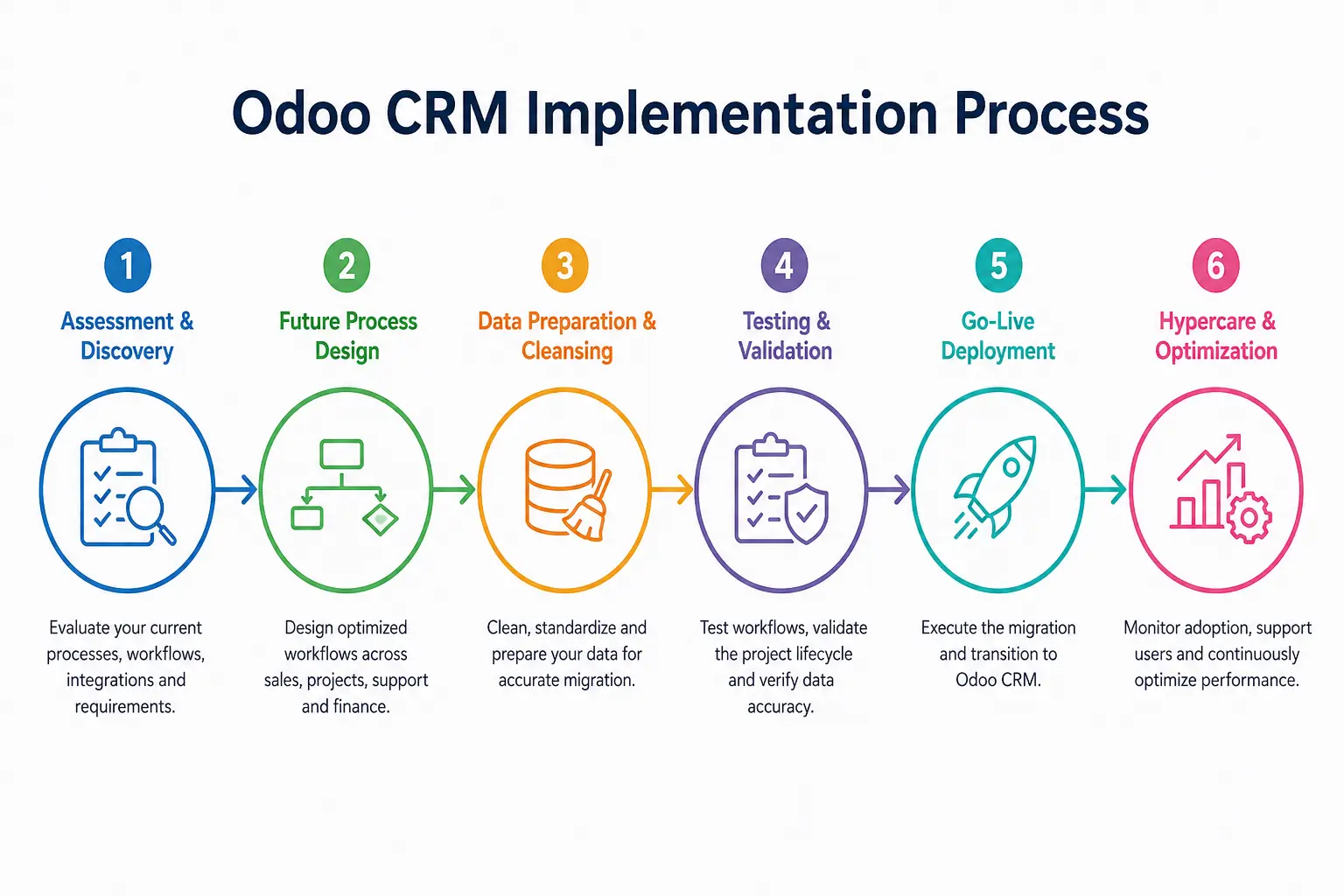
BrowseInfo helps companies update their customer and project management systems by using an approach to move to a new system.
Our services include :
CRM assessment and consulting
Insightly CRM migration strategy
Data migration and validation
Odoo CRM implementation
Project workflow optimization
Process redesign and automation
Third-party integrations
User training and change management
Post go-live optimization support
Our goal is to help companies create systems that connect their customers and projects and make it easier to see what is going on work efficiently and grow in the long term.
Frequently Asked Questions
1. Can Odoo CRM replace Insightly CRM?
Yes. Odoo CRM can replace Insightly CRM while also providing integrated project management, accounting, inventory, helpdesk, procurement and ERP functionality.
2. Which platform is better for project-based businesses?
Both platforms support project-oriented organizations. Odoo provides broader integration across operational departments and financial workflows.
3. Does Odoo include project management?
Yes. Odoo includes integrated project management, task tracking, resource planning, timesheets and project reporting capabilities.
4. Which CRM provides better operational visibility?
Odoo generally offers greater operational visibility because CRM, projects, accounting, inventory, support and ERP processes share a common database.
5. Which platform has a lower total cost of ownership?
Odoo often delivers a lower TCO by consolidating multiple business applications into a unified platform.
6. Is Odoo suitable for scaling organizations?
Yes. Odoo's modular architecture allows businesses to start with CRM and projects while expanding into ERP, accounting, inventory, HR and other operational areas as they grow.
Final Thoughts
The choice between CRM and Odoo CRM depends on whether a company needs a system that just manages customers and projects or a system that manages the whole business.
Companies that just need to manage customers and projects may still be happy, with CRM.
Companies that want to have an understanding of their operations and want to make their business processes more efficient and want to grow often find that Odoo CRM is a good choice.
The best customer relationship management strategies connect the way a company gets customers executes projects manages finances and supports customers into one system that makes the company more efficient helps people work together and makes the company grow in the long term.
