Executive Summary
ERP modernization is no longer just a technical upgrade — it is a strategic shift toward better visibility, efficiency, and control.
Modern organizations migrate from SAP Business One to Odoo to reduce complexity, improve integration, and enable real-time decision-making across finance, operations, and supply chain.
The real goal is not system replacement, but business transformation with measurable outcomes such as:
Faster decision-making
Better operational visibility
Reduced manual effort
Improved scalability
Unified business data
Why Businesses Consider ERP Migration?
Most companies don’t migrate because their ERP has failed — they migrate because their business has evolved.
Over time, organizations face:
Multiple disconnected tools
Heavy dependency on spreadsheets
Rising maintenance and licensing costs
Limited automation and reporting flexibility
Modern business models now demand real-time dashboards, automation, mobility, and integrated CRM + ERP workflows — where Odoo fits naturally.
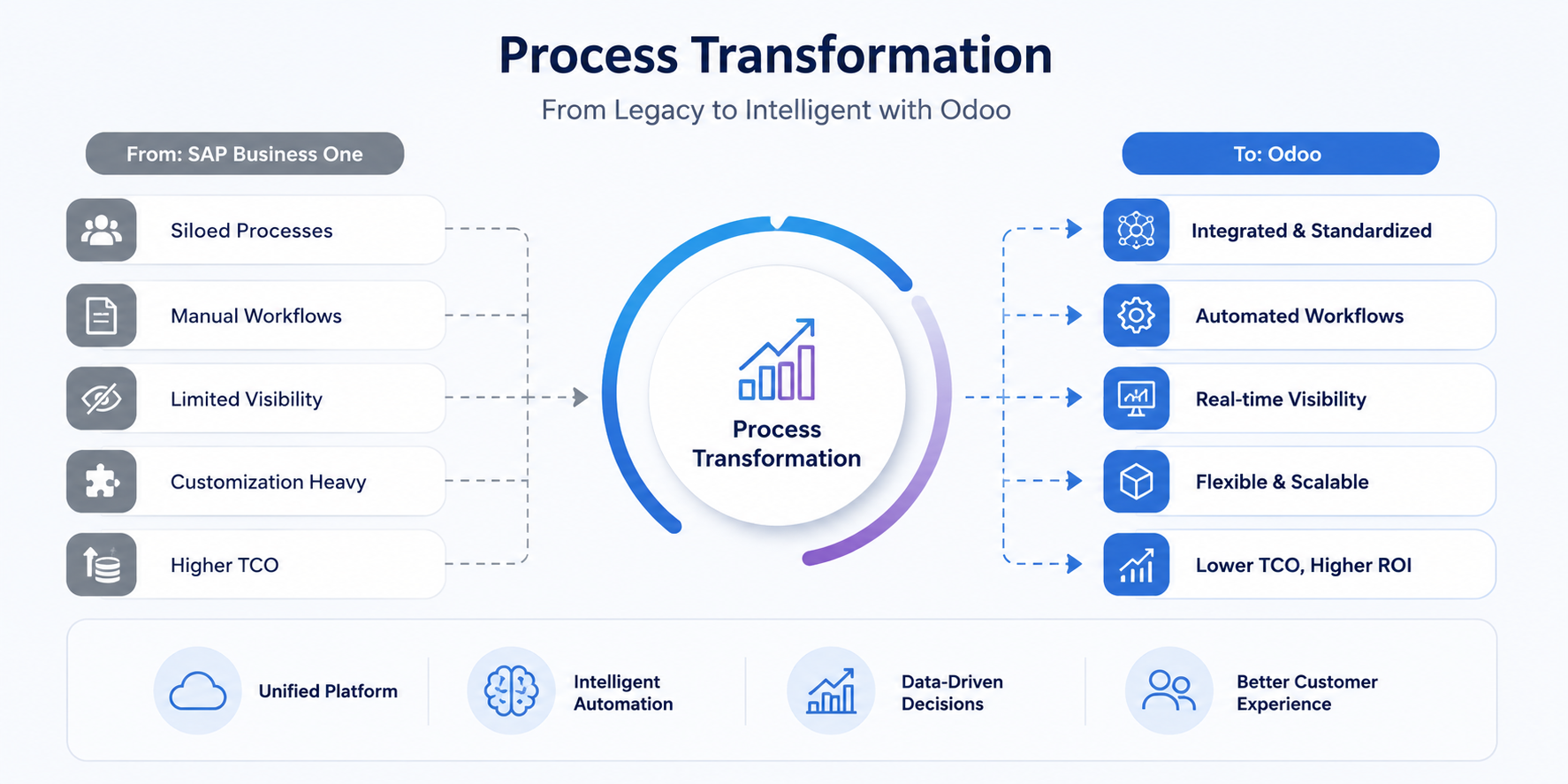
Signs Your Current ERP is Holding You Back
If these challenges sound familiar, your system may be limiting growth:
Financial reports depend heavily on Excel
Inventory mismatches occur frequently
Production planning lacks visibility
CRM and sales data are disconnected
Forecasting is slow or unreliable
When these issues combine, it signals a need for ERP modernization.
SAP Business One vs Odoo (Quick Comparison)
| Feature Area | SAP Business One | Odoo |
|---|---|---|
| Total Cost | Medium–High | Low–Medium |
| CRM | Add-on system | Built-in |
| Customization | Limited | High flexibility |
| Inventory | Strong | Strong |
| Reporting | Standard | Advanced & real-time |
| Mobile Access | Moderate | Strong |
| Scalability | Medium | High |
| Integration | Complex | Easy via APIs |
Key Insight: SAP focuses on structured enterprise stability, while Odoo focuses on flexible, modular growth.
When Staying on SAP Business One Still Makes Sense?
Migration is not always required.
SAP Business One may still be suitable when:
Current operations are stable
Users are well-trained and adopted
Growth is predictable and limited
Existing system meets reporting needs
Upgrade costs are still justified
ERP decisions should always follow business strategy, not software trends.
Key Risks in ERP Migration
ERP transformation success depends on managing three critical risks:
Data Quality Risk: Poor or duplicate data leads to incorrect reporting
Process Risk: Copying old workflows instead of improving them
Change Risk: Low training and poor adoption reduce ROI
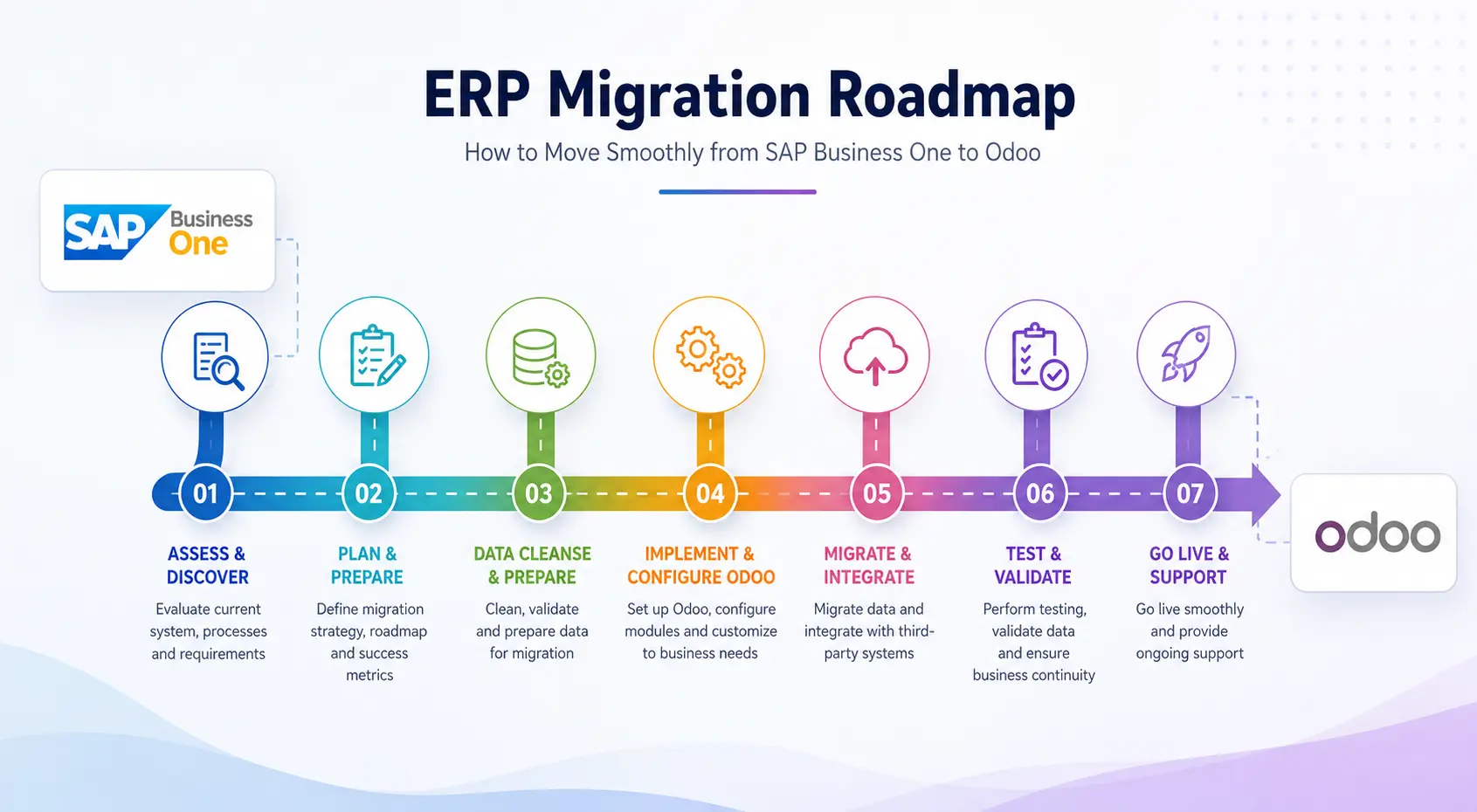
ERP Migration Roadmap
Instead of complexity, ERP migration follows a clear flow:
1
Assessment & Discovery
2
Future Process Design
3
Data Preparation
4
System Setup
5
Testing & Validation
6
Go-Live & Hypercare
Industry Focus Snapshot
| Industry | Key Focus | Outcome |
|---|---|---|
| Manufacturing | Production, BOM, quality | Better shop-floor control |
| Retail | Inventory, POS | Faster fulfillment |
| Distribution | Warehousing, logistics | Stock accuracy |
| Services | Projects, billing | Improved profitability |
Cost vs Value Perspective
ERP modernization is not about simply cutting software expenses or choosing the lowest-cost solution. It is about creating long-term business value through better efficiency, automation, and decision-making capabilities.
Cost Drivers
Licensing
Training
Value Outcomes
Faster reporting
Reduced manual work
Better inventory control
Improved customer experience
Higher operational efficiency
ERP Migration Decision Guide
Choose Odoo if:
You need flexibility and customization
You want unified CRM + ERP
You require scalable architecture
You want lower long-term cost
Stay on SAP Business One if:
Your processes are stable
Reporting meets requirements
Growth is predictable
System adoption is strong
Final Thoughts
ERP migration is not just a software decision — it is fundamentally a business growth decision that shapes how an organization operates, scales, and competes in the long run. It impacts every core function, from finance and operations to customer experience and decision-making speed.
Organizations that treat ERP modernization as a strategic transformation initiative rather than a simple tool replacement are far more likely to succeed. This approach ensures better user adoption, stronger process alignment, and significantly higher return on investment over time.
Higher ROI
Better adoption
Long-term scalability
Odoo offers a strong alternative for companies looking to simplify operations and build a future-ready digital foundation.
Frequently Asked Questions
1.Why do companies migrate from SAP Business One to Odoo?
Organizations typically seek greater flexibility, improved user adoption, lower ownership costs, stronger integration capabilities, and a more unified business platform.
2.How long does migration take?
The timeline depends on business complexity, data volume, customization requirements, and integration scope.
3.What data can be migrated?
Organizations commonly migrate customers, vendors, products, inventory, balances, open transactions, and selected historical records.
4.What is the biggest migration risk?
Poor data quality and inadequate change management are among the most common risk factors.
5.Can Odoo support manufacturing operations?
Yes. Odoo supports production planning, work orders, quality management, maintenance, inventory management, and traceability.
6.Is Odoo suitable for multi-company operations?
Yes. Odoo supports multi-company and multi-location business structures.
