Executive Summary
A lot of stores start with basic tools like a website, accounting software, shipping tools, spreadsheets and connections to other marketplaces. This works fine when they are small. Things get complicated really fast as they get more orders, more products and start selling in more places.
It becomes hard to keep track of products on websites make sure you have the right amount of stock manage the warehouse deal with customers and get good reports when all your information is in different systems.
As online stores get bigger it is just as important to have everything running smoothly as it is to make money. Companies need a system that connects everything like sales, stock, buying, warehouse, accounting, customer service and reports.
This is why a lot of stores use Odoo to organize their business. Of using different programs for different parts of the company Odoo gives them one place to do everything. This helps stores automate tasks see what is going on better reduce busywork and support growth over time. Odoo is a help, to eCommerce companies because it connects sales, inventory, procurement, warehousing, accounting, customer management and reporting all in one place, which makes it easier for them to manage their eCommerce business.
Why Growing eCommerce Businesses Standardize on Odoo
Growth introduces new challenges that many businesses do not anticipate.
A company that processes fifty orders per day operates very differently from one processing several thousand orders across multiple sales channels.
As operations expand, businesses often require:
- Centralized inventory visibility
- Multi-channel order management
- Warehouse automation
- Procurement planning
- Customer relationship management
- Financial visibility
- Business-wide reporting
Odoo enables organizations to manage these functions within a single platform rather than relying on multiple disconnected applications.
Signs Your Current Systems Are Creating Operational Bottlenecks
1. Inventory Data Differs Across Channels
The stock levels you see on marketplaces and websites and your internal records are often not the same.
2. Reporting Requires Multiple Systems
Your teams have to spend a lot of time putting together information from different applications before your management can make any decisions.
3. Manual Order Processing Is Increasing
Your employees have to keep entering data from one system to another.
4. Procurement Decisions Are Reactive
You run out of inventory because the people who buy things for your company do not have the information to predict what will be needed.
5. Customer Information Is Fragmented
Your sales team and your support team and your finance team are all using different customer records.
6. Warehouse Operations Are Becoming More Complex
You are getting orders and this is causing delays and mistakes, with your inventory.
7. Business Growth Is Increasing Technology Complexity
You keep adding new software to try to solve the problems you are having with how your company runs.
8. Operational Visibility Is Limited
Your management team does not have a picture of how things are going in all the different parts of your company.
Traditional eCommerce Stack vs Odoo Strategic Comparison
| Capability | Multiple eCommerce Tools | Odoo |
|---|---|---|
| Cost Structure | Multiple Subscriptions | Unified Platform |
| Inventory | Separate Systems | Integrated |
| Accounting | External Software | Built-In |
| CRM | Separate Tool | Built-In |
| Procurement | Limited | Automated |
| Reporting | Fragmented | Centralized |
| Warehouse Management | Partial | Advanced |
| Integrations | Multiple Vendors | Unified Architecture |
| Automation | Limited | Extensive |
| Scalability | Moderate | High |
| Upgrade Path | Complex | Modular Growth |
When Your Existing Systems May Still Be Sufficient
Businesses may continue with their existing technology stack when it still meets operational needs, supports growth goals and does not introduce significant inefficiencies or integration challenges.
- Operations remain relatively simple
- Inventory volumes are low
- Sales channels are limited
- Reporting requirements are basic
- Existing workflows remain efficient
- Expansion plans are minimal
Operational Risks of Delaying Standardization
1.Data Inconsistency
Different systems have information and this can be a problem because they often contain conflicting information about the Data.
2.Inventory Errors
If the systems are not synchronized properly we can end up with overselling or stock shortages which's not good for the Inventory.
3.Reporting Delays
Decision-makers often lack accurate visibility into business performance because they do not have access to reliable, real-time reporting and consolidated business metrics.
4.Higher Operational Costs
When we have different applications it becomes very hard to manage everything which increases the administrative overhead and the costs of maintaining all these applications are Higher Operational Costs.
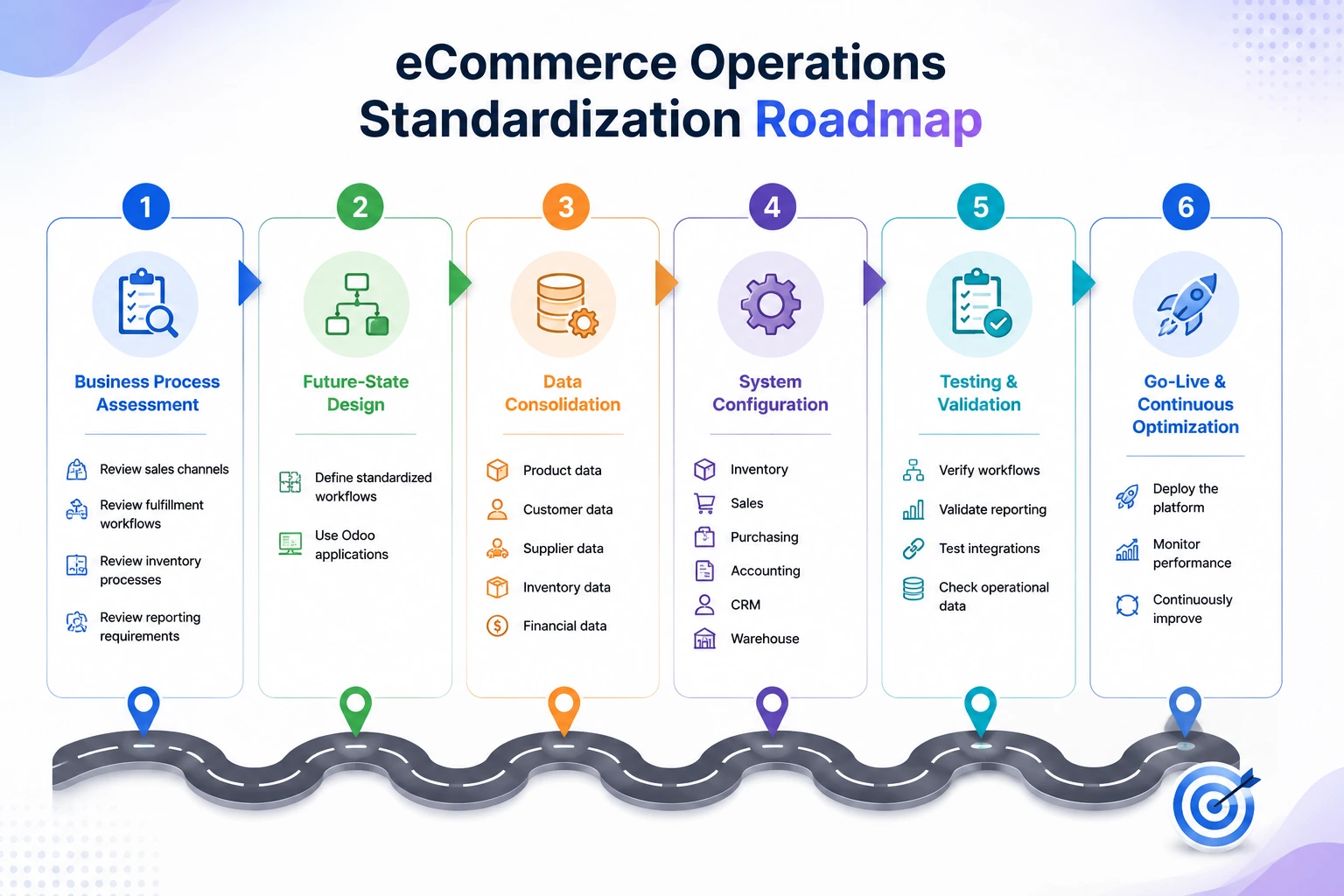
Odoo eCommerce Operations Transformation Roadmap
Industry-Specific Considerations
D2C Brands
Often require:
- Subscription management
- Customer segmentation
- Marketing automation
- Loyalty programs
Marketplace Sellers
Need:
- Centralized inventory
- Order synchronization
- Fulfillment visibility
- Performance reporting
Wholesale eCommerce
Require:
- Procurement automation
- Multi-warehouse management
- Customer pricing rules
- Inventory forecasting
Cost and ROI Considerations
Organizations often realize value through:
| Area | Expected Benefit |
|---|---|
| Inventory | Better stock accuracy |
| Operations | Reduced manual work |
| Reporting | Faster decisions |
| Procurement | Improved purchasing control |
| Warehousing | Better fulfillment efficiency |
| Customer Service | Improved response times |
Decision Matrix
You Should Evaluate Odoo If
✓ Inventory accuracy is becoming difficult
✓ Reporting is fragmented
✓ Multiple applications manage different departments
✓ Order volume is growing rapidly
✓ Manual work continues to increase
✓ Operational visibility is limited
✓ Multi-channel selling is expanding
You May Stay on Existing Systems If
✓ Current workflows remain efficient
✓ Inventory complexity is low
✓ Reporting requirements are basic
✓ Expansion plans are limited
✓ Existing software meets business needs
Common Standardization Mistakes
- Automating inefficient processes
- Ignoring inventory data quality
- Delaying process redesign
- Excessive customization
- Insufficient user training
- Lack of executive sponsorship
- Poor change management planning
How Browseinfo Supports eCommerce ERP Modernization
Browseinfo helps eCommerce organizations improve operational efficiency by streamlining workflows, automating key business processes and integrating sales, inventory and accounting systems into a unified platform.
- Odoo Implementation Services
- Odoo Migration Services
- Odoo Inventory Solutions
- Odoo CRM Implementation
- Odoo Accounting Solutions
- Odoo Warehouse Management Solutions
- Odoo Integration Services
- Odoo Customization Services
- Odoo Support Services
Frequently Asked Questions
1. Why do eCommerce businesses choose Odoo?
Odoo puts everything in one place so you have inventory and accounting and customer relationship management and purchasing and warehouse operations. Reporting all together.
2. Can Odoo manage sales channels?
Yes. Odoo can handle your website and marketplaces and wholesale operations and retail sales from the same place.
3. Is Odoo suitable for growing retailers?
Yes. Odoo is made to grow with you as your orders and inventory and operations get more complicated.
4. Can Odoo improve inventory accuracy?
Yes. With Odoo you can see what is in stock now so you do not run out of things or sell things you do not have. Odoo helps you keep track of your inventory.
5. Does Odoo support warehouse management?
Yes. Odoo helps with everything in the warehouse like moving inventory and picking and receiving and fulfilling orders. Odoo has tools, for all of these things.
6. Can Odoo procurement?
Yes. Odoo can help you buy things automatically. It helps you manage your suppliers and make sure you have enough stock. Odoo makes buying things easier.
7. What benefits do businesses typically see after standardizing on Odoo?
Businesses that use Odoo usually see a lot of things happen like their inventory is more accurate and their reports are better and things get done automatically. Businesses that use Odoo also have an understanding of what is going on and they can work more efficiently. They get better at managing Odoo and their business.
Final Thoughts
Rapid growth can show the weaknesses in eCommerce systems that are not connected. When the number of orders the complexity of inventory and what customers expect get bigger businesses usually need things to be done in a consistent and visible way.
Using Odoo to make operations the same helps organizations manage things like inventory, sales, buying things storing things, accounting and relationships with customers all from one place. For eCommerce businesses that are growing this makes a stronger base for operations that helps the business get bigger automate things and do well in the long term. Odoo helps eCommerce businesses like this because it makes things easier to manage and understand, which is important, for eCommerce businesses that want to keep growing and doing well.
