Introduction
Employees are one of the most valuable assets in any organization. Whether a company has 20 employees or 2,000, managing workforce information, recruitment, attendance, leave requests, performance reviews and employee development can quickly become complex. As organizations grow, relying on spreadsheets, emails and disconnected HR systems often creates inefficiencies, compliance risks and administrative challenges.
HR teams are not about keeping employee records and handling payroll anymore. Modern HR departments play a role in finding and keeping talent, engaging employees, planning the workforce managing performance, and growing the organization. To do these jobs businesses need systems that give employee data, simple workflows and real-time updates on workforce operations.
Odoo HR Management offers a platform that helps organizations manage the whole employee process from hiring and orientation to tracking attendance, managing time off, evaluating performance and developing employees. This guide explores the features, advantages and best practices of Odoo HR Management and explains how it helps businesses create more efficient and productive workforces.
Why HR Management Is Important
Human Resource Management affects every part of an organization. Recruiting the right talent, maintaining employee records, managing attendance, tracking performance and ensuring compliance all contribute to business success.
When HR tasks are done by hand companies often run into problems, like inaccurate employee info, slow approvals different rules being followed and too much paperwork. These problems get bigger as the company grows.
A good HR management system helps businesses make employees happier, do paperwork, follow the rules better and give managers a clearer picture of their workforce.
What Is Odoo HR Management?
Odoo HR Management is a suite of integrated human resource applications designed to manage workforce operations from a single platform.
The HR ecosystem in Odoo includes modules for:
- Employee Management
- Recruitment
- Attendance Tracking
- Leave Management
- Employee Appraisals
- Payroll
- Expenses
- Fleet Management
- Employee Skills Management
Because these applications are integrated, organizations can manage employee information and HR processes without relying on multiple disconnected systems. This centralized approach improves visibility and operational efficiency across the HR department.
Core Features of Odoo HR Management
Employee Information Management
Managing employee records is one of the most fundamental HR responsibilities.
Odoo allows businesses to maintain a centralized employee database that includes personal information, job roles, departments, contracts, work history, skills, certifications and organizational structures.
Instead of storing information across spreadsheets and documents HR teams gain a single source of truth for employee data. This improves data accuracy and simplifies workforce administration.

Recruitment Management
Hiring the right employees is essential for business growth.
Odoo Recruitment helps organizations manage the hiring process from job posting to candidate selection. HR teams can track applicants, manage interviews, evaluate candidates and collaborate with hiring managers through a structured recruitment workflow.
Benefits include:
- Faster hiring processes
- Improved candidate tracking
- Better recruitment visibility
- More efficient collaboration
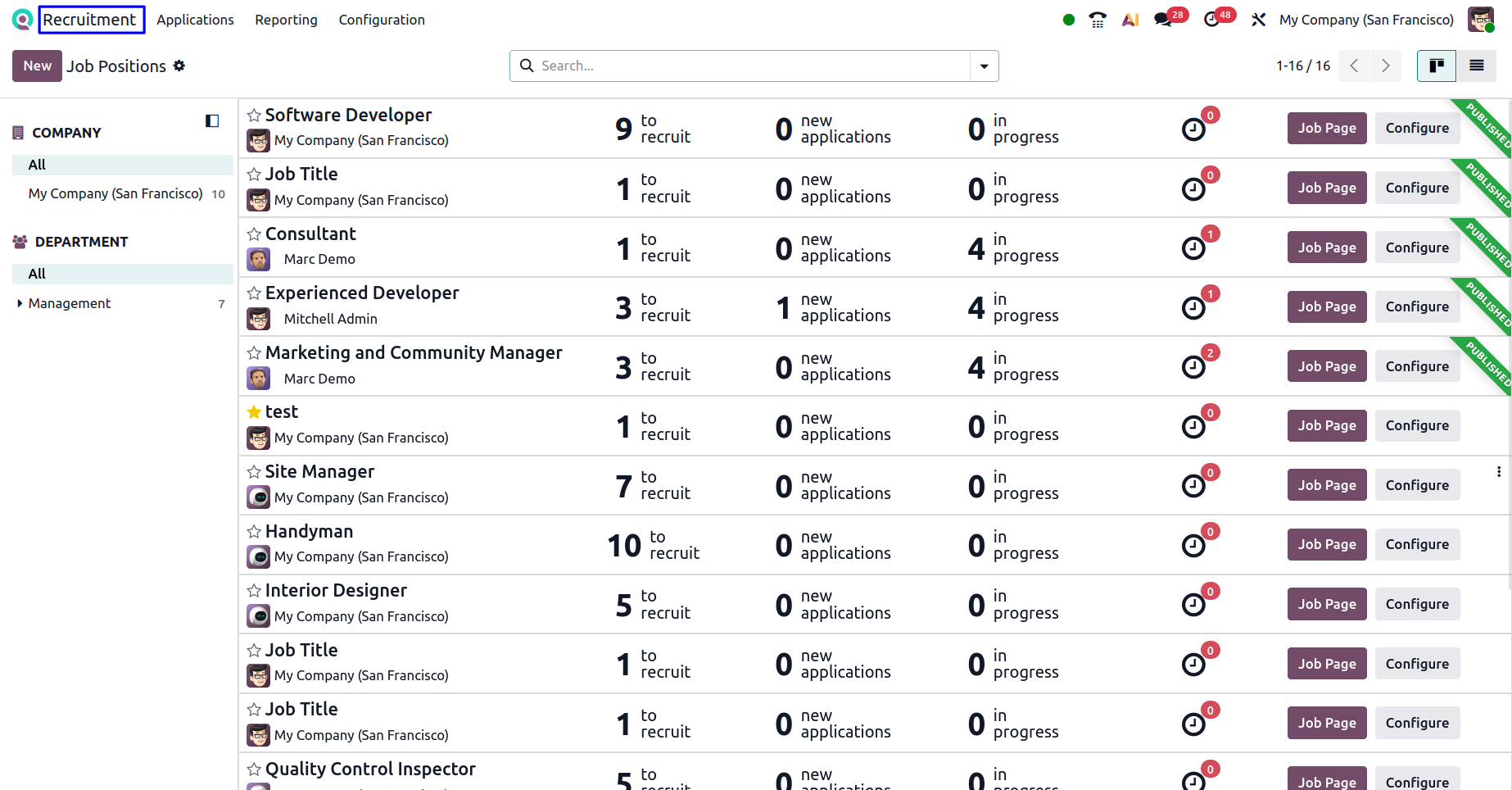
Recruitment data remains connected to employee records once candidates are hired.
Employee Onboarding
The onboarding experience often influences how quickly new employees become productive.
Odoo helps organizations streamline onboarding activities by providing visibility into tasks, documentation requirements, equipment allocation and training activities. A structured onboarding process helps improve employee engagement while reducing administrative effort.

Odoo HR Features and Business Benefits
| Feature | Business Benefit |
|---|---|
| Employee Management | Centralized workforce data |
| Recruitment | Faster hiring processes |
| Attendance Tracking | Improved workforce visibility |
| Leave Management | Automated leave approvals |
| Payroll Integration | Better payroll accuracy |
| Performance Appraisals | Employee development support |
| Expense Management | Simplified reimbursement processes |
| Employee Self-Service | Reduced HR workload |
Attendance Management
Tracking employee attendance accurately is important for workforce planning, payroll processing and compliance.
Odoo Attendance lets employees check in and out. It also helps managers see whos showing up on time, working hours, overtime and absenteeism.

Automated attendance tracking reduces manual record-keeping and helps organizations maintain accurate workforce data. For companies with large workforces this functionality can significantly reduce administrative overhead.
Leave and Time-Off Management
Managing employee leave requests manually often results in approval delays and policy inconsistencies.
Odoo Leave Management automates the process by allowing employees to submit requests electronically while managers review and approve them through predefined workflows.
The system helps businesses:
- Track leave balances
- Manage vacation requests
- Monitor employee availability
- Improve policy compliance
Employees gain transparency into their leave status while managers can plan resources more effectively.
Payroll Management
Payroll accuracy is very important for employee satisfaction and following rules.
Odoo Payroll integrates employee records, attendance data, contracts and compensation structures to support payroll processing. This integration reduces manual calculations and improves payroll accuracy.
Companies get a picture of payroll costs and reduce the work HR staff has to do. For businesses having all payroll information in one place is one of the best things, about using a unified HR system.
Employee Performance Management
Modern HR departments increasingly focus on employee development rather than annual performance reviews alone.
Odoo Appraisals helps organizations conduct structured performance evaluations, establish goals, collect feedback and monitor employee progress. Managers can use performance data to support employee development initiatives and workforce planning activities.
Benefits include:
- Improved performance visibility
- Better employee engagement
- Stronger development planning
- More consistent evaluation processes
Performance management becomes an ongoing process rather than a periodic event.
Expense Management
Managing employee expenses manually often causes delays and increases work for administrators.
Odoo Expenses allows employees to submit expense claims electronically, attach supporting documents, and track approval status. Managers can review and approve expenses through automated workflows.
The system improves transparency while simplifying reimbursement processes. Organizations also gain better visibility into employee spending patterns and expense trends.
Employee Self-Service Capabilities
One of the biggest advantages of modern HR systems is empowering employees to manage routine activities independently.
Odoo's employee self-service functionality allows employees to:
- View personal information
- Submit leave requests
- Access attendance records
- Update profile details
- Submit expenses
This reduces administrative workloads while improving employee experiences. HR teams can focus on strategic initiatives instead of routine administrative tasks.
HR Reporting and Analytics
Data-driven decision-making is becoming increasingly important in human resources management.
Odoo provides reporting capabilities that help organizations analyze:
- Workforce growth
- Recruitment performance
- Employee attendance
- Leave trends
- Payroll costs
- Employee turnover
These insights support workforce planning and help leadership teams make informed HR decisions. Accurate reporting also improves organizational transparency and accountability.
Common HR Challenges and Odoo Solutions
| HR Challenge | Odoo Solution |
|---|---|
| Manual Employee Records | Centralized employee database |
| Recruitment Delays | Recruitment management workflows |
| Attendance Tracking Issues | Automated attendance system |
| Leave Approval Delays | Leave management automation |
| Payroll Complexity | Integrated payroll processing |
| Expense Management Challenges | Digital expense workflows |
| Limited Workforce Visibility | Real-time dashboards |
| Administrative Overload | Employee self-service tools |
Best Practices for Odoo HR Management
Organizations achieve the best results when technology is combined with effective HR processes.
Some recommended practices include:
- Maintain accurate employee records
- Standardize HR workflows
- Automate routine approvals
- Conduct regular performance reviews
- Use workforce analytics for planning
These practices help maximize the value of Odoo HR Management.
Common HR Management Mistakes to Avoid
Many workforce challenges arise because organizations lack standardized processes rather than because of technology limitations.
Common mistakes include:
- Maintaining outdated employee records
- Delaying performance reviews
- Relying on manual attendance tracking
- Inconsistent leave policies
- Limited workforce reporting
Addressing these issues helps improve operational efficiency and employee experiences.
How Odoo HR Supports Business Growth
When a business gets bigger it gets more complicated to manage people. You have to deal with employees, departments and places and you have to follow more rules. This means you have to do administrative work.
Odoo HR is a system that can grow with your business. It helps you keep track of your people. Makes it easier to expand. Because everything is connected you can manage things like employee information and time off easily. You can also see how your workforce is doing, which helps you make decisions.
This means Odoo HR is a choice for businesses that want to be efficient for a long time. Odoo HR supports business growth and helps you manage your people well.
Frequently Asked Questions
1. What is Odoo HR Management?
Odoo HR Management is a suite of applications that helps businesses manage recruitment, employee records, attendance, leave, payroll, performance and workforce operations.
2. Does Odoo support recruitment management?
Yes. Odoo Recruitment helps organizations manage job postings, applications, interviews and candidate evaluations.
3. Can Odoo track employee attendance?
Yes. Odoo Attendance provides check-in, check-out, attendance monitoring and workforce visibility features.
4. How does Odoo manage employee leave?
Employees can submit leave requests electronically while managers approve requests through automated workflows.
5. Does Odoo include payroll functionality?
Yes. Odoo Payroll integrates employee information, attendance data, contracts and compensation structures.
6. What is employee self-service in Odoo?
Employee self-service allows employees to access personal information, request leave, submit expenses and manage HR-related activities independently.
7. Can Odoo support performance evaluations?
Yes. Odoo Appraisals helps businesses manage employee reviews, feedback and performance tracking.
8. Which businesses benefit from Odoo HR Management?
Manufacturing companies, service organizations, retailers, distributors, healthcare providers and growing businesses of all sizes can benefit from Odoo HR.
Conclusion
Odoo HR Management helps businesses streamline workforce operations by centralizing recruitment, employee records, attendance, leave management, payroll and performance tracking within a single platform. This integrated approach improves visibility, reduces administrative work and enhances overall HR efficiency.
By combining automation, workforce analytics and employee management tools, Odoo enables organizations to improve employee experiences, strengthen workforce planning and build a scalable HR foundation that supports long-term growth and business success.
